
Corfu Airport (CFU) Guide
Corfu Airport (CFU) Guide — Terminal, Arrivals and Getting Into Corfu
Corfu International Airport carries the IATA code CFU and the name Ioannis Kapodistrias. It sits about 3 km south of Corfu Town, operates a single passenger terminal for domestic and international flights, and connects to the town centre by road in roughly ten minutes.
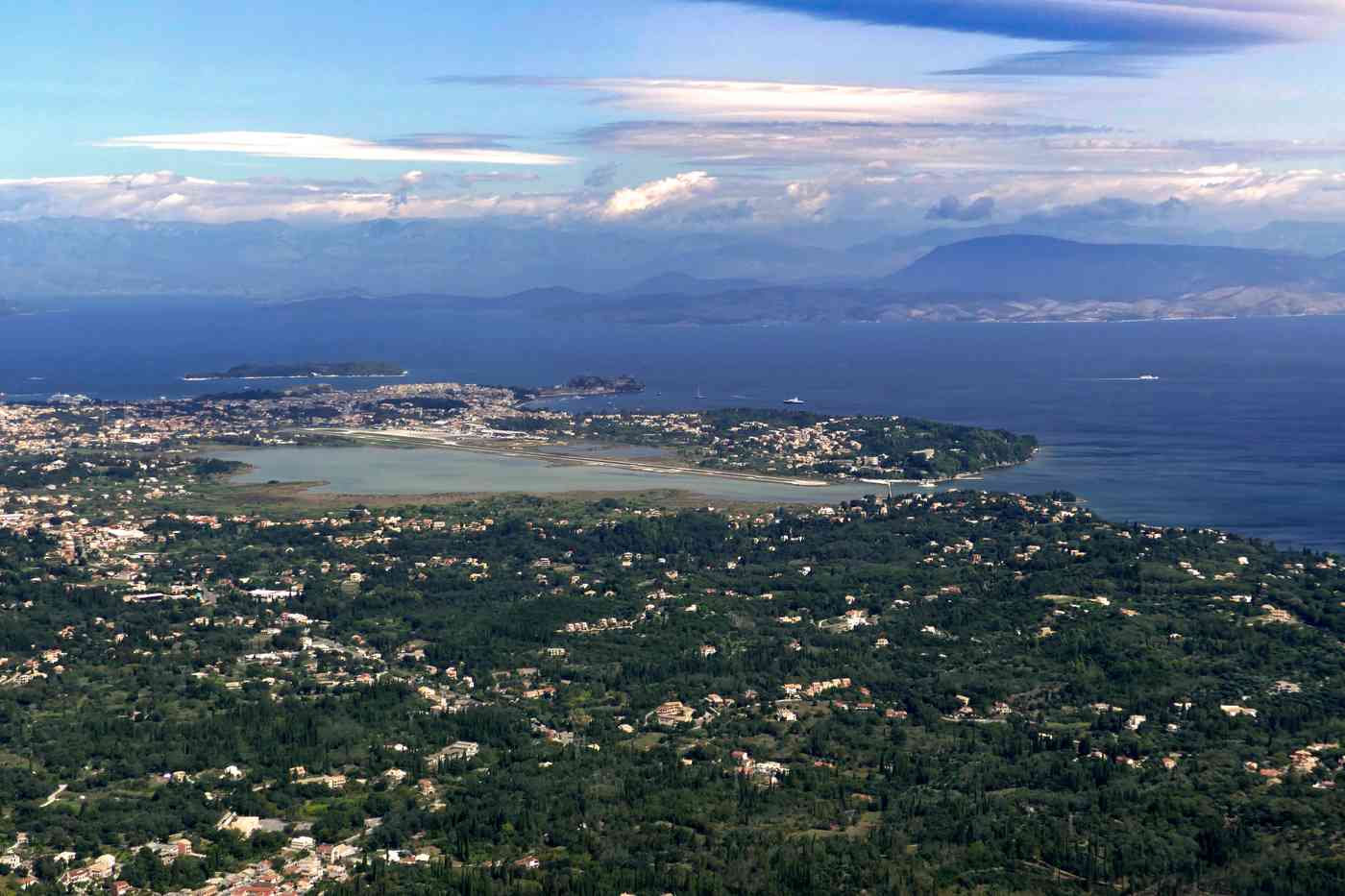
CFU is one of the most compact major airports in Greece, and it is the closest to its island capital of any of them. The runway runs along a spit between the Chalikiopoulou lagoon and the sea, which produces the low approach over water that arriving passengers remember. This guide covers the terminal, the arrival sequence, the transport options and the practical points that shape a landing here.
Where is Corfu Airport and how far is it from Corfu Town?
Corfu Airport sits about 3 km south of Corfu Town centre and about 4 km from Corfu Port. The Kanoni peninsula lies immediately east of the runway, and the resort coast begins 7 km north.
The airport occupies the strip of land between the Chalikiopoulou lagoon and the eastern shore, which places it inside the built-up area of the capital rather than out in the countryside. That proximity is unusual and it changes the arithmetic of an arrival: the transfer into town takes minutes rather than the half-hour or more that most Greek island airports involve.
Approximate road distances from the terminal set the scale of the island from the moment of landing.
| Destination | Approximate road distance from CFU |
|---|---|
| Corfu Town centre | 3 km |
| Corfu Port | 4 km |
| Kanoni | 4 km |
| Kontokali | 7 km |
| Gouvia | 9 km |
| Kommeno | 11 km |
| Dassia | 12 km |
| Ipsos | 14 km |
| Paleokastritsa | 25 km |
| Kassiopi | 36 km |
| Sidari | 37 km |
| Acharavi | 38 km |
| Kavos | 47 km |
Corfu measures 64 km from north to south, so no destination on the island sits more than about 47 km from the terminal. A traveller landing at CFU is within an hour’s drive of every resort, beach and village on Corfu.
How is the Corfu Airport terminal laid out?
CFU operates one passenger terminal that handles domestic and international traffic together. The ground floor holds check-in, baggage reclaim and the exits to taxis and buses, which keeps the whole arrival on a single level.
The single-terminal layout is the defining practical feature of the airport. There is no inter-terminal transfer, no shuttle between buildings and no long internal walk. A passenger clearing baggage reclaim reaches the exit within a short distance.
The building divides into three zones from a passenger’s point of view.
- Enter the ground-floor arrivals area from the apron, through passport control where the route requires it
- Collect luggage from the baggage reclaim hall on the same level
- Exit to the forecourt, where taxis, buses and meeting points sit directly outside
Departures use the same building. Check-in counters sit on the ground floor, with security and the gate area beyond them. The compact footprint means the walk from the entrance to a gate is short by the standards of a European holiday airport.
The scale of the terminal matters most in July and August, when charter traffic concentrates arrivals and departures into the same hours. The building handles the volume, but the queues at those peaks are the airport’s main pressure point rather than the distances inside it.
What happens when you land at Corfu Airport?
Passengers arriving from Schengen countries proceed directly to baggage reclaim. Passengers arriving from outside the Schengen area pass through passport control first, where EU biometric passport holders can use the automated gates.
The arrival sequence splits by where the flight originated, and knowing which route applies removes the uncertainty from the first ten minutes on the ground.
Schengen arrivals
Flights from Germany, Italy, Poland, Austria, the Netherlands and the other Schengen states route straight to baggage reclaim without a routine immigration check. Border police carry out identity checks at the gate on occasion, depending on the security posture at the time.
Non-Schengen arrivals
Flights from the United Kingdom and other non-Schengen origins pass through passport control before baggage reclaim. EU citizens holding biometric passports use the automated e-gates. Other passengers queue for manual processing by a border officer and complete any entry documentation the route requires.
Domestic arrivals
Flights from Athens and the other Greek airports arrive without immigration formalities and go straight to reclaim.
Baggage reclaim itself is a single hall on the ground floor. The compact building means the walk from the aircraft to the belt is short, though delivery times lengthen when three or four charter flights land within the same window.
The exit leads onto the forecourt, where taxis wait, the bus stop sits and meet-and-greet representatives hold name boards. A step-by-step account of the rental handover at this point sits in Car Rental Pickup In Corfu: A Smooth Step-By-Step Guide For Airport And Port Arrivals.
How do you get from Corfu Airport to Corfu Town?
Three options cover the 3 km into the capital: the blue city bus on route 15 to San Rocco square, a taxi from the forecourt, or a rental car collected at the terminal. The bus takes roughly 15 to 20 minutes.
The short distance makes every option viable, which is unusual for an island airport. The choice turns on luggage, party size and what happens after the first night.
The blue bus — route 15
The blue city bus network links the airport with the town centre on route 15, calling at San Rocco square and the intercity bus station. The journey runs roughly 15 to 20 minutes. Services follow a published timetable and thin outside the summer season, so a late arrival checks the last departure before relying on it.
Taxi
Taxis wait on the forecourt outside arrivals. The run into the town centre covers 3 km. A taxi suits a party arriving with hold luggage and no plans to drive, and it becomes expensive for a holiday that involves repeated outings, because each journey restarts the charge.
Rental car
A car collected at the terminal removes the transfer entirely and covers the rest of the island afterwards. A representative meets the flight in front of arrivals with a name board, so the handover happens at the terminal rather than at an off-site depot. The full rate card and terms for Corfu Airport Cars sit on the home page.
Onward transport for a party staying in Corfu Town is a fourth consideration: the old quarter is walked rather than driven, so a car parked at the accommodation matters more than one used daily. That trade-off is set out on the Corfu Town Car Rental page.
How do you reach the resorts from Corfu Airport?
The east-coast road north reaches Kontokali at 7 km, Gouvia at 9 km, Dassia at 12 km and Ipsos at 14 km. The northern resorts at Kassiopi, Acharavi and Sidari sit 36 to 38 km out, and Kavos 47 km south.
Resort transfers from CFU divide into three bands, and the band decides whether a bus, a taxi or a car makes sense.
The near coast — 7 to 14 km
Kontokali, Gouvia, Kommeno, Dassia and Ipsos all sit on the east-coast road within twenty-five minutes. The road is sealed and well graded for its whole length, passing Corfu Town and the port on the way. Each of these resorts is covered in detail on its own page, including Gouvia Car Rental and Dassia Car Rental.
The west coast — 16 to 25 km
Glyfada, Agios Gordios, Ermones and Paleokastritsa lie across the island. The roads climb over the central ridge, so journey times run longer than the distances suggest. Paleokastritsa at 25 km involves the bending descent past Lakones.
The far north and far south — 36 to 47 km
Kassiopi, Acharavi, Roda and Sidari occupy the north coast at 36 to 38 km. Kavos sits at the southern tip at 47 km on a wider, faster road. Both bands are comfortable drives and awkward bus journeys, because the public network radiates from Corfu Town rather than from the airport.
The bus point matters for planning. KTEL intercity services run from the bus station in Corfu Town, not from the terminal, so a bus journey to a resort begins with the route 15 transfer into town and a change there.
Which facilities does Corfu Airport have?
The terminal holds ATMs in the arrivals area, toilets immediately beyond baggage claim, cafés, duty-free and retail on the departures side, and car rental desks and meeting points on the arrivals forecourt.
Facilities match the airport’s scale: sufficient rather than expansive, and arranged so that everything sits within a short walk.
- Withdraw cash at the ATMs in the arrivals area, which matters because rural fuel stations and village tavernas prefer cash
- Use the toilets immediately after baggage claim, which are free to use
- Buy food and drink at the cafés, concentrated on the departures side
- Shop at the duty-free and retail units after security on departure
- Meet rental representatives and transfer drivers on the arrivals forecourt
Two practical notes follow from the compact layout. The retail and catering offer sits mostly beyond security, so a long wait before check-in has fewer options than a long wait after it. And the seating in the departures area comes under pressure at the summer peaks, when three or four charter departures cluster.
Cash withdrawal before leaving the airport is the single most useful preparation for a driving holiday on Corfu. Fuel stations on the coastal corridor take cards routinely; those in the hill villages and the far north are less consistent.
What makes the approach into Corfu Airport distinctive?
The runway runs along a narrow strip between the Chalikiopoulou lagoon and the sea, so aircraft descend low over water on the final approach. The Kanoni peninsula, Pontikonisi and the Vlacherna monastery sit beside the flight path.
The geography of the site produces one of the more photographed approaches in Greece. The runway occupies the spit that separates the shallow lagoon from the open water, with Corfu Town’s rooftops and the Old Fortress visible beyond it on one side and the Albanian mainland across the channel on the other.
Three features define the landing from a passenger’s seat.
- Watch the descent cross the lagoon, with the water close beneath the wing on the final approach
- Look for Pontikonisi, the wooded islet at the mouth of the lagoon, and the Vlacherna monastery on its causeway
- Look north across the town toward the Old Fortress on its twin-peaked promontory
The same geography puts the Kanoni viewpoint directly under the approach path on the far side of the lagoon, which is why aircraft spotters and photographers gather there. Kanoni sits 4 km from the terminal and is itself worth an afternoon.
The lagoon setting also explains the airport’s compact footprint. The site cannot expand outward, which is why the single terminal handles the whole traffic rather than a spread of buildings.
When is Corfu Airport busiest?
Traffic peaks between June and September, with the heaviest volume on Saturday and Sunday charter turnaround days. Winter service is limited to domestic routes and a small number of international connections.
Corfu runs a strongly seasonal air market, and CFU reflects it more sharply than a year-round hub does. Understanding the pattern shapes both the arrival experience and the planning around it.
Peak season — June to September
Charter and scheduled traffic from the United Kingdom, Germany, Italy and Poland concentrate into the summer months, and within them into weekend turnaround days. Arrivals and departures cluster into the same windows, which is when the terminal queues form.
Shoulder season — May and October
Traffic thins and the terminal runs comfortably. Rental availability broadens and published rates sit below peak, which is the practical reason the shoulder months suit a driving holiday.
Winter — November to March
Service reduces to domestic connections and a limited international schedule. The island is quiet, roads run clear, and most seasonal businesses close.
Two planning consequences follow. A summer arrival on a Saturday allows more time for baggage reclaim and the exit than a midweek one. And a late-evening summer landing, common on the charter schedule, benefits from arranging onward transport in advance rather than at the forecourt. Seasonal patterns for the whole island are covered in Best Time To Rent A Car In Corfu: Save Money, Avoid Sellouts, And Drive Stress-Free.
Where do flights to Corfu Airport come from?
CFU handles domestic services from Athens and the Greek network alongside international traffic from the United Kingdom, Germany, Italy, Poland, Austria, the Netherlands and the Nordic countries, concentrated in the summer schedule.
The route map is holiday-driven, which is why it expands so markedly between spring and summer and contracts again in autumn.
Three traffic types share the terminal.
Domestic flights connect Corfu to Athens and, seasonally, to other Greek airports. These operate through the winter and give the island its year-round air link.
Scheduled international flights run from the major European markets across the season, with the United Kingdom and Germany carrying the largest volumes.
Charter flights fill the summer peak, arriving on fixed weekly rotations that concentrate on weekend turnaround days.
The mix explains the airport’s rhythm. A Wednesday morning in May and a Saturday afternoon in August produce very different experiences of the same building, and planning around the second is worth the effort.
How do you meet a car rental representative at Corfu Airport?
The representative waits in front of the international or national arrivals exit holding a board with the customer’s name. The handover happens at the terminal, with no shuttle bus and no off-site depot transfer.
Meet-and-greet works differently from a rental desk, and the difference matters most on a late arrival. A desk closes at a published hour; a representative meets the flight that actually lands.
The sequence runs in four steps.
- Clear passport control where the route requires it, then collect luggage from reclaim
- Walk out through the arrivals exit onto the forecourt
- Look for the representative holding a name board directly in front of the doors
- Present the driving licence and identification, sign the agreement and take the keys
Delayed flights are handled by waiting rather than rescheduling. Triple Seven staff wait at the airport until the delayed flight lands, at no extra cost, which removes the risk that a two-hour delay costs a day of the holiday.
Customers who prefer to settle into accommodation first take delivery at the hotel or villa instead, at the agreed time. Both arrangements are set at booking. Reservations start on the Book Your Car page, and the team answers questions through the Corfu Airport Rent a Car contact page.
What is worth seeing near Corfu Airport?
Kanoni sits 4 km from the terminal, looking across the lagoon mouth to Pontikonisi and the Vlacherna monastery. Corfu Town’s UNESCO old quarter lies 3 km north, and the Achilleion palace at Gastouri about 10 km south-west.
The airport’s position inside the capital’s built-up area means four of the island’s best-known sights sit within a short drive of the runway.
Kanoni and the lagoon — 4 km
The Kanoni viewpoint looks out over the mouth of the Chalikiopoulou lagoon to the Vlacherna monastery on its causeway and Pontikonisi, the wooded islet behind it. The Mon Repos estate occupies the same peninsula. The site sits directly across the water from the runway.
Corfu Town old quarter — 3 km
The UNESCO-listed old town holds the Liston arcade, the Spianada, the Old and New Fortresses and the Campiello quarter. It is walked rather than driven, with parking at Saroko and along Garitsa Bay.
The Achilleion, Gastouri — about 10 km
The palace built for Empress Elisabeth of Austria and later owned by Kaiser Wilhelm II stands in terraced gardens above the east coast, reached by a climbing road through Gastouri village.
Benitses and the southern coast — from 11 km
The coastal road south leads to Benitses, Messonghi and eventually the Korission Lagoon, with the long southern sand beaches beyond.
A first afternoon covering Kanoni and the old town works from the terminal without any planning at all, which suits an early arrival with a hotel check-in still hours away. Wider route ideas sit in Best Scenic Drives In Corfu Island: 8 Stunning Road Trips For Coastal Views, Villages And Hidden Bays.
Corfu Airport (CFU) — frequently asked questions
How far is Corfu Airport from Corfu Town?
The terminal sits about 3 km south of the town centre, which is the shortest airport-to-capital distance of any major Greek island. The drive takes around ten minutes outside peak traffic, and the blue bus on route 15 covers it in roughly 15 to 20 minutes.
How many terminals does Corfu Airport have?
CFU operates one passenger terminal handling both domestic and international flights. There is no inter-terminal transfer and no shuttle between buildings. Arrivals, baggage reclaim and the exits sit together on the ground floor.
What is the full name of Corfu Airport?
The airport is Corfu International Airport “Ioannis Kapodistrias”, named after the first head of state of independent Greece. Its IATA code is CFU. Locally it is also referred to by the island’s Greek name, Kerkyra.
Do I go through passport control at Corfu Airport?
Passengers arriving from Schengen countries proceed directly to baggage reclaim. Passengers arriving from outside the Schengen area, including the United Kingdom, pass through passport control first, where EU biometric passport holders can use the automated gates.
Is there a bus from Corfu Airport to the town?
The blue city bus runs on route 15 between the airport and the town centre, calling at San Rocco square and the intercity bus station, in roughly 15 to 20 minutes. Services follow a published timetable and reduce outside the summer season.
Can I get a bus from Corfu Airport directly to the resorts?
The KTEL intercity network radiates from the bus station in Corfu Town rather than from the terminal, so a resort journey begins with the route 15 transfer into town and a change there. A taxi or a rental car covers the trip directly.
Are there ATMs at Corfu Airport?
ATMs are available in the arrivals area. Withdrawing cash before leaving is worth doing for a driving holiday, because rural fuel stations and village tavernas away from the eastern corridor are less consistent about card payment.
How early do travellers arrive for a departure from CFU?
Departure timing follows the airline’s published guidance rather than an airport rule. Summer weekends concentrate three or four charter departures into the same window, so the queues at check-in and security run longer then than on a midweek morning in May.
Why is the landing at Corfu Airport so dramatic?
The runway occupies a narrow strip between the Chalikiopoulou lagoon and the sea, so aircraft descend low over water on the final approach. Pontikonisi, the Vlacherna monastery and the Kanoni peninsula sit beside the flight path, with Corfu Town beyond.
What can I do near the airport on arrival day?
Kanoni sits 4 km away with its view across the lagoon to Pontikonisi. Corfu Town’s UNESCO old quarter lies 3 km north. The Achilleion palace at Gastouri sits about 10 km south-west. All three fit an afternoon before a hotel check-in.
Where do rental representatives meet arriving passengers?
Representatives wait in front of the international or national arrivals exit holding a board with the customer’s name. The handover happens at the terminal itself, with no shuttle bus and no off-site depot transfer involved.
What happens if my flight into Corfu is delayed?
Triple Seven staff wait at the airport until the delayed flight lands, at no extra cost. A delay in collection that does not stem from the flight is reported to the company in advance, because an uninformed late collection attracts hourly charges.
How far is Corfu Airport from Corfu Port?
The port sits about 4 km north of the terminal, on the far side of the town centre. It handles ferries from Igoumenitsa and the Italian ports, crossings to Saranda in Albania, and cruise calls through the season. Details sit on the Corfu Port Car Rental page.
Corfu International Airport is documented at Corfu International Airport, and the island itself is covered on the Corfu Airport Rent a Car guide.
Which other Corfu locations and guides are worth reading?
Triple Seven covers seven pick-up locations across Corfu and publishes a travel guide for each of them. The rental pages carry rates, delivery and terms; the guides carry the place itself.
Corfu car rental locations
- Gouvia Car Rental
- Corfu Town Car Rental
- Corfu Port Car Rental
- Ipsos Car Rental
- Dassia Car Rental
- Kommeno Car Rental
- Kontokali Car Rental
Corfu travel guides
- Corfu Port Guide
- Corfu Town Guide
- Ipsos Guide
- Dassia Guide
- Gouvia Guide
- Kommeno Guide
- Kontokali Guide