
Corfu Town Guide
Corfu Town Guide — the UNESCO Old Town, Fortresses and What to See
Corfu Town is the island’s capital and a UNESCO World Heritage Site, built on a Venetian street plan between two fortresses. It sits about 3 km north of Corfu Airport and 2 km from Corfu Port, and its historic core is walked rather than driven.
The town is unlike anywhere else in Greece. Four centuries of Venetian rule, followed by French and British administrations, left a capital of tall tenements, arcaded terraces and an open esplanade where cricket is still played. This guide covers the quarters, the fortresses, the museums, the practicalities and how to see the town in a day or in a week.
Why is Corfu Town a UNESCO World Heritage Site?
The old town holds one of the best-preserved Venetian urban plans in the Mediterranean, shaped by fortifications built between the 15th and 19th centuries. Its street pattern, defensive works and layered Venetian, French and British architecture earned the listing.
The listing rests on the town as a whole rather than on individual monuments. Corfu was a Venetian possession for roughly four centuries, and the town grew inside walls that constrained its footprint. That constraint produced the density that defines it: tall buildings, narrow lanes and small courtyards packed between the two fortresses.
Three layers of rule left visible marks.
- Trace the Venetian centuries in the fortifications, the tenement height and the street grid of the Campiello
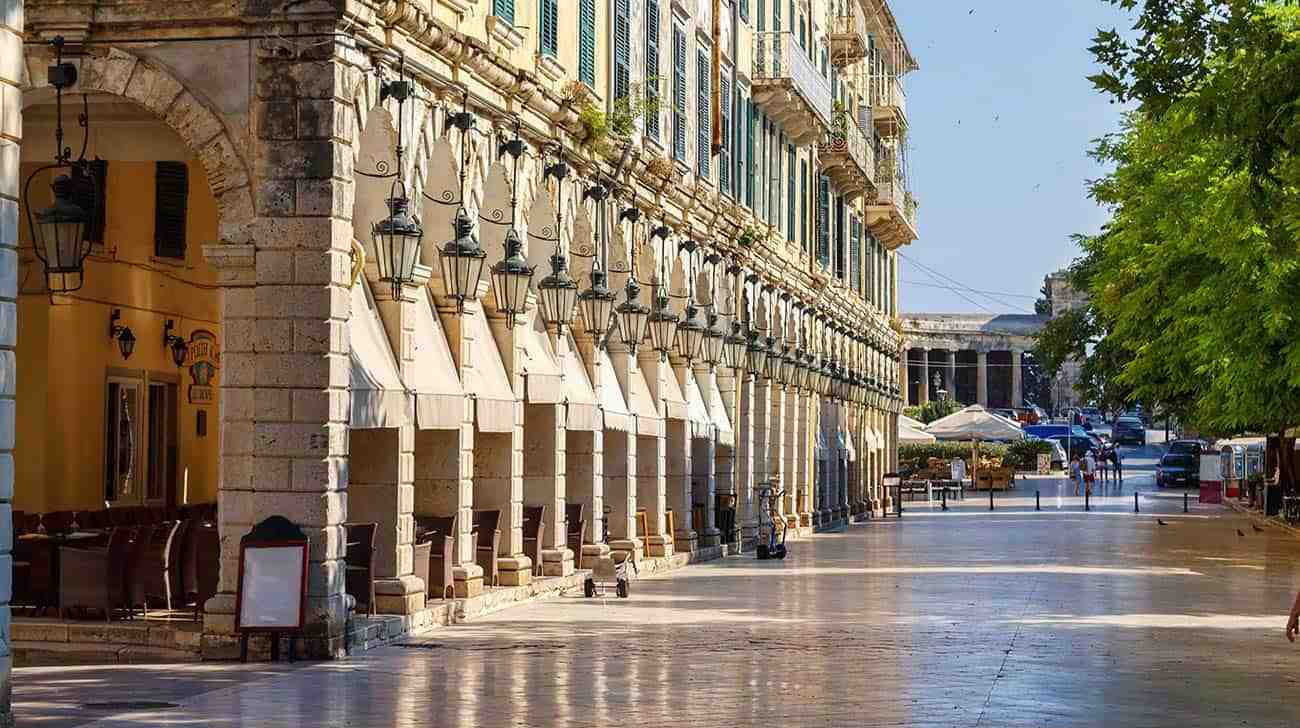
- Trace the French period in the Liston arcade facing the esplanade, built in the Napoleonic era
- Trace the British period in the Palace of Saint Michael and Saint George, the cricket on the Spianada and the Victorian bandstand
The result is a Greek town that reads as Italian at first glance and then reveals the other two hands. Walking it is the point: the interest lies in the fabric between the monuments rather than in any single building.
What are the main quarters of Corfu Town?
The Campiello is the oldest and densest quarter, north of the Spianada. The Spianada and Liston form the open civic heart. Garitsa lies south along the bay, Mandouki north toward the port, and Saroko sits on the western edge.
The town divides into distinct areas, and knowing which is which shortens the first afternoon considerably.
The Campiello — the old core
The medieval quarter behind the Liston holds the narrowest lanes in the town, with washing lines strung between tall tenements and small squares opening without warning. It is entirely pedestrian in practice.
The Spianada and the Liston — the civic centre
The Spianada is the large open esplanade between the old quarter and the Old Fortress, cleared originally as a field of fire for the fortress guns and now a park with a cricket ground and a Victorian bandstand. The Liston, the arcaded terrace along its western edge, carries the cafés.
Garitsa — the southern bay
The seafront south of the Old Fortress runs along Garitsa Bay, with neoclassical frontages, marked parking bays and a promenade. It is quieter than the centre and leads on toward Kanoni.
Mandouki — the port district
The area between the historic centre and the New Port is residential and working rather than touristic. Every walker arriving from a ship passes through it.
Saroko — the modern hub
San Rocco square on the western edge is the town’s transport and commercial hub, with the bus connections and the main parking. It is where most drivers leave the car.
What are the two fortresses of Corfu Town?
The Old Fortress occupies a twin-peaked promontory east of the Spianada, separated from the town by a moat. The New Fortress stands on the hill above the New Port, covering the western approaches.
Both are Venetian works and both are open to visitors, and between them they explain the shape of the town.
The Old Fortress
The promontory carried the town’s earliest defences and was cut off from the mainland by an artificial channel, the Contrafossa, which still separates it. The site holds Venetian bastions, a British-era garrison church and views back across the Spianada to the rooftops and out to the mainland.
The New Fortress
Built later on the hill above the modern port, the New Fortress covers the western approaches and looks down over the harbour. Its ramparts and tunnels are the less-visited of the two, and the view over the port and the channel is the reason to climb.
The pairing is what made the town defensible: one fortress facing the sea approach from the east, the other covering the harbour and the land side. The town grew in the space between them, which is why it built upward rather than outward.
Allow half a day for both if the interest is historical, or pick the Old Fortress alone for the view and the setting.
Which museums are worth visiting in Corfu Town?
The Museum of Asian Art occupies the Palace of Saint Michael and Saint George on the Spianada. The Byzantine Museum holds religious icons from the 13th to the 17th centuries, and the archaeological collection covers the ancient city.
The town’s museums are small by capital-city standards and unusually specific, which makes them easy to fit around a day of walking.
Museum of Asian Art
Housed in the neoclassical palace built for the British Lord High Commissioner at the northern end of the Spianada, this holds a substantial collection of Asian objects. The palace itself is worth the entry.
Byzantine Museum
The Antivouniotissa museum displays religious icons spanning the 13th to the 17th centuries, in a church setting in the old quarter.
Archaeological collection
The town’s archaeological holdings cover the ancient city and the wider island, including material from the Palaiopolis site on the Kanoni peninsula.
Smaller collections
The town also holds a banknote museum, a Serbian museum recording the First World War evacuation of the Serbian army to Corfu, and the Casa Parlante house museum.
The Palaiopolis site at Kanoni, 4 km south, extends the archaeological interest outside the town and combines with the Mon Repos estate on the same peninsula.
What can you do in Corfu Town in one day?
A single day covers the Spianada and Liston, the Old Fortress, the Campiello lanes, the Church of Saint Spyridon and the seafront at Garitsa, all on foot within a compact area.
The town rewards a day precisely because it is small. Everything in the historic core sits within a walk of everything else.
A workable sequence runs in five stages.
- Start at the Spianada, walk the Liston arcade and take a coffee facing the cricket ground
- Cross to the Old Fortress over the Contrafossa channel and climb for the view back over the rooftops
- Return through the Campiello, letting the lanes lead rather than following a route
- Visit the Church of Saint Spyridon, whose red-domed bell tower is the tallest in the town and the easiest landmark to navigate by
- Finish along the Garitsa seafront, or climb to the New Fortress for the harbour view
Timing matters more than the route. The lanes are coolest and emptiest before 10:00 and after 17:00, and the middle of a July day in the Campiello is hard work. Cruise-call mornings concentrate visitors into the same hours.
The town is compact enough that a car adds nothing inside it and a great deal outside it. Parking and access are set out on the Corfu Town Car Rental page.
How do you get around Corfu Town?
The historic core is walked. Vehicles use the ring around it, with parking at Saroko, along Garitsa Bay and near the New Port. Blue city buses serve the town and the airport, and KTEL intercity buses leave from the bus station.
Movement in the town divides sharply between the historic core and everything around it.
On foot
The Campiello, the Liston, the Spianada and the approaches to both fortresses are covered on foot in a compact area. The surface is stone rather than asphalt, which argues for comfortable shoes rather than any other preparation.
By car
Cars use the ring road and the seafront rather than the core. Marked bays sit at Saroko, along Garitsa Bay and near the New Port. Lanes inside the Campiello narrow below the width of a modern hatchback, so the core is not a driving proposition at all.
By bus
The blue city buses link the town with the airport on route 15 and with the near suburbs. The KTEL intercity network runs from the bus station to the resorts and villages across the island.
By boat
Excursion boats leave from the Old Port beside the historic centre, while cruise ships and international ferries use the New Port to the north-west.
The practical pattern for a visitor with a car is to park once and walk the rest. Detail on the airport connection sits on the Corfu Airport (CFU) Guide, and on the sea gateway on the Corfu Port Guide.
Where do you eat and drink in Corfu Town?
The Liston arcade holds the best-known terraces facing the Spianada. The Campiello lanes and the market streets behind hold the smaller tavernas, bakeries and food shops at lower prices.
Eating in the town separates into two bands, and both are worth using for different purposes.
The Liston is a setting rather than a bargain. The arcade faces the cricket ground and the Old Fortress, and the price reflects the view. It suits a coffee or an evening drink more than a full meal.
The lanes behind carry the working tavernas. Prices fall as the streets narrow, and the food shops sell the island specialities: kumquat products, local olive oil and the preserved goods particular to Corfu.
Three practical points apply.
- Book or arrive early on cruise-call evenings, when the terraces fill in one wave
- Carry cash for the smaller shops, though card payment is routine across the centre
- Look for the tavernas a street back from the Spianada rather than on it
Corfiot cooking differs from the mainland Greek repertoire, carrying Venetian influence in dishes built around slow-cooked meat and spiced sauces. Asking for the local dish rather than the familiar one is the shortest route to the difference.
When is the best time to visit Corfu Town?
May, June, September and October offer warm weather, open businesses and thinner crowds. July and August bring the heaviest visitor numbers and the hottest walking conditions in the enclosed lanes.
The town’s season follows the island’s, with one difference: the old quarter’s density makes summer heat more noticeable here than on the coast.
Spring — April to June
The island is green, the temperature suits walking, and the town runs at a comfortable pace. Greek Easter in Corfu is a major event with its own traditions and draws visitors in its own right.
High summer — July and August
Charter traffic peaks and cruise calls cluster. The lanes hold the heat through the middle of the day, which makes early mornings and evenings the usable hours.
Autumn — September and October
Warmth holds, the sea stays swimmable, and visitor numbers fall. This is the strongest combination for a town-focused visit.
Winter — November to March
The town runs at local pace, with the museums and restaurants that serve residents staying open while seasonal businesses close. Rain is more likely, and Corfu is among the wetter Greek islands.
Seasonal patterns for driving and touring the wider island sit in Best Time To Rent A Car In Corfu: Save Money, Avoid Sellouts, And Drive Stress-Free.
What is worth seeing just outside Corfu Town?
Kanoni sits 4 km south with the Vlacherna monastery and Pontikonisi. The Achilleion palace at Gastouri lies about 10 km south-west, Paleokastritsa 25 km north-west and Mount Pantokrator to the north.
The town works as a base precisely because so much sits within a short drive.
Kanoni, Vlacherna and Pontikonisi — 4 km
The peninsula south of the town looks across the mouth of the Chalikiopoulou lagoon to the Vlacherna monastery on its causeway and the wooded islet of Pontikonisi. The Mon Repos estate and the Palaiopolis archaeological site occupy the same ground.
The Achilleion, Gastouri — about 10 km
The palace built for Empress Elisabeth of Austria and later owned by Kaiser Wilhelm II stands in terraced gardens above the east coast, reached by a climbing road through the village.
Paleokastritsa and the west coast — 25 km
The bay divides into coves beneath wooded headlands, with boat trips to the sea caves and the Byzantine fortress of Angelokastro on the cliff above.
Mount Pantokrator — the island’s summit
The highest point on Corfu at 906 metres, reached by a climbing road from the north-east coast, with a monastery at the top and views across the island and the channel.
Route ideas for all four sit in Best Scenic Drives In Corfu Island: 8 Stunning Road Trips For Coastal Views, Villages And Hidden Bays, and the wider island on the Corfu Airport Rent a Car guide.
What is the history of Corfu Town?
Corfu passed from Venetian rule, lasting roughly four centuries, to a brief French administration and then to a British protectorate, before union with Greece in the 19th century. Each period left visible layers in the town.
The town’s appearance is the direct product of who governed it, and the sequence explains the mixture better than any single building does.
The Venetian centuries
Venice held Corfu for roughly four hundred years, and the island never fell under Ottoman rule as most of Greece did. That continuity is why the architecture reads as Italian: tall tenements, shuttered façades, arcaded streets and the two fortresses that define the town’s plan. The olive groves that cover much of the island date from Venetian agricultural policy.
The French period
French administration in the Napoleonic era left the Liston, the arcaded terrace facing the Spianada, modelled on the Rue de Rivoli in Paris. It is the town’s most photographed frontage.
The British protectorate
British rule in the 19th century produced the Palace of Saint Michael and Saint George at the head of the Spianada, the cricket played on the esplanade, the Victorian bandstand and a network of public works across the island.
Union with Greece
The Ionian Islands joined the Greek state in the 1860s. The town’s later history includes the First World War evacuation of the Serbian army to Corfu, recorded in a museum in the town.
The practical value of the sequence for a visitor is that it turns a walk into a reading exercise. The fortifications, the arcade and the palace each belong to a different administration, and they sit within a few hundred metres of each other.
Which churches and landmarks define the Corfu Town skyline?
The Church of Saint Spyridon carries the tallest bell tower in the town, red-domed and visible from most of the old quarter. The Old Fortress on its promontory and the New Fortress on its hill frame the skyline from the sea.
Four structures dominate the view of the town from the water and from the fortress walls, and they double as the easiest navigation aids inside the lanes.
The Church of Saint Spyridon
Dedicated to the island’s patron saint, whose relics it holds, the church stands in the heart of the old quarter. Its red-domed campanile is the tallest in the town, which makes it the reference point when the Campiello lanes lose their sense of direction.
The Old Fortress
The twin peaks of the promontory carry the Venetian bastions and, at the summit, the structures that give the fortress its distinctive profile from the sea.
The New Fortress
The hill above the New Port carries the later fortifications, with ramparts looking down over the harbour.
The Palace of Saint Michael and Saint George
The neoclassical palace at the northern end of the Spianada, built for the British Lord High Commissioner, closes the esplanade and now houses the Museum of Asian Art.
Navigating the old quarter works better by landmark than by map. The bell tower gives the bearing, the Spianada gives the open edge, and the sea gives the outer boundary on two sides.
What do first-time visitors need to know about Corfu Town?
Five points cover the essentials: the core is pedestrian, the surface is stone, the heat concentrates in the lanes, the town holds no swimming beach, and everything historic sits within a compact walk.
A first visit runs more smoothly with a handful of expectations set in advance.
- Walk the historic core rather than driving into it, and park on the ring at Saroko or Garitsa
- Wear footwear suited to stone rather than asphalt, because the lanes and squares are paved in it
- Plan the outdoor walking for before 10:00 and after 17:00 in July and August
- Treat beach days as drives, because the town’s own strips are small
- Allow the lanes to lead, because the Campiello rewards wandering more than a fixed route
Two further points help. Cruise-call days change the character of a morning, so checking whether ships are in port shapes the plan. And the town’s museums are indoor, cool and small, which makes them the natural use of the hottest hours rather than an afternoon sacrifice.
The town also runs later than a visitor from northern Europe expects. Restaurants fill from mid-evening onward, and the Liston and the Spianada are at their most animated well after dark.
What are the busiest times in Corfu Town?
The old quarter fills between 10:00 and 16:00 in July and August, and on cruise-call mornings whatever the month. Early mornings and evenings after 17:00 are consistently the quietest hours.
Crowding here is concentrated rather than constant, which makes it straightforward to work around.
Four patterns recur.
- Expect the Liston and the Spianada to fill from mid-morning through the afternoon in high season
- Expect a sharper wave on cruise-call days, when ships discharge passengers into the same two or three hours
- Expect the Campiello lanes to hold the heat through the middle of a July day
- Expect the parking bays at Saroko and Garitsa to fill alongside the streets
The counter-pattern is simple. Walk the old quarter before 10:00 or after 17:00, and use the middle of the day for the museums, which are indoors and cooler, or for a drive out of town.
Evening is the town at its best. The lanes cool, the terraces on the Liston fill in a way that suits them, and the fortress walls take the last light. That is also when the town most rewards staying in it rather than visiting it.
How does Corfu Town compare with the island’s resorts?
The town offers architecture, museums and restaurants within walking distance and no swimming beach. The east-coast resorts offer beaches on the doorstep and a drive of 6 to 14 km into the capital.
The choice between them decides how a holiday feels day to day, and both work with a car.
A town base makes the evenings walkable and the beach days a drive. The old quarter, the fortresses and the museums sit outside the door, and Dassia at 10 km or Glyfada at 13 km carry the swimming.
A resort base reverses it. Gouvia at 7 km, Dassia at 10 km, Ipsos at 12 km and Kontokali at 6 km all put the water on the doorstep and the town within a short drive for an evening out.
Three factors decide between them.
- Weigh evening walkability against morning beach access, because a base gives one or the other
- Weigh parking convenience, which favours the resorts, against sightseeing convenience, which favours the town
- Weigh the shape of the holiday, because a touring itinerary suits the town’s central position
The resorts nearest the capital split the difference most successfully. Kontokali at 6 km is the closest of them, covered on the Kontokali Car Rental page, with Dassia at 10 km on the Dassia Car Rental page.
Is Corfu Town a good base for a holiday?
The town suits a visitor who wants museums, restaurants and architecture within walking distance each evening. It holds no real swimming beach, so beach days involve a drive of 10 to 25 km to either coast.
Three factors decide whether the capital works as a base rather than a day trip.
Walkability is the strongest argument for it. The old quarter, the fortresses, the museums and the restaurants all sit on foot from a central address, which removes the evening transport question entirely.
Beach access is the argument against it. Garitsa and Mon Repos hold small strips rather than swimming beaches. Dassia at 10 km, Glyfada at 13 km and Paleokastritsa at 25 km are the realistic options, all requiring transport.
Position is the deciding factor for a touring holiday. Every destination on Corfu falls within 44 km of the town, and both coasts sit inside 25 km, which no resort base matches.
The alternative pattern is to stay on the east coast at Gouvia, Dassia or Kontokali, all within 10 km, and treat the town as a regular evening trip. Those options are covered on the Gouvia Car Rental and Kontokali Car Rental pages, while rates for Corfu Airport Car Rentals sit on the home page.
Corfu Town — frequently asked questions
Is Corfu Town a UNESCO World Heritage Site?
The old town holds UNESCO World Heritage status, awarded for its Venetian fortifications and its exceptionally well-preserved urban plan. The listing covers the town as an ensemble rather than individual monuments, which is why walking the fabric matters more than ticking off buildings.
How long do you need in Corfu Town?
One full day covers the Spianada, the Liston, the Old Fortress, the Campiello lanes and the Church of Saint Spyridon on foot. Two days adds the New Fortress, the museums and the Kanoni peninsula 4 km south.
Can you drive in Corfu Old Town?
The Campiello quarter and the streets around the Liston are laid out for pedestrians and narrow below the width of a modern hatchback. Vehicles use the ring around the core, with parking at Saroko, along Garitsa Bay and near the New Port.
Where do you park in Corfu Town?
Marked bays sit at Saroko square on the western edge, along the Garitsa Bay seafront to the south, and near the New Port to the north-west. Bays fill through the middle of the day in July and August, so early or late arrivals are easier.
What is the Liston in Corfu?
The Liston is the arcaded terrace along the western edge of the Spianada, built during the French period in the Napoleonic era. Its arcade is lined with cafés and restaurants and it faces the esplanade and the Old Fortress beyond.
What is the Spianada?
The Spianada is the large open esplanade between the old quarter and the Old Fortress, originally cleared as a field of fire for the fortress guns. It now holds a park, a cricket ground introduced under British rule and a Victorian bandstand.
How many fortresses does Corfu Town have?
Two. The Old Fortress occupies a twin-peaked promontory east of the Spianada, cut off from the town by an artificial channel. The New Fortress stands on the hill above the New Port, covering the western approaches and the harbour.
How far is Corfu Town from the airport?
The airport sits about 3 km south of the town centre, the shortest airport-to-capital distance of any major Greek island. The drive takes around ten minutes and the blue bus on route 15 covers it in roughly 15 to 20 minutes.
Is there a beach in Corfu Town?
The town holds small strips at Garitsa and near Mon Repos rather than a swimming beach. Dassia at 10 km, Glyfada at 13 km on the west coast and Paleokastritsa at 25 km are the nearest genuine beaches, all reached by road.
What is the best month to visit Corfu Town?
September and October combine warm weather, a swimmable sea and thinner crowds. May and June work equally well with greener landscapes. July and August bring the heaviest visitor numbers and make the enclosed lanes hot through the middle of the day.
What food is Corfu Town known for?
Corfiot cooking carries Venetian influence and differs from the mainland Greek repertoire, built around slow-cooked meat and spiced sauces. The town’s food shops also sell kumquat products and local olive oil, both particular to the island.
Is Corfu Town walkable?
The historic core is compact and entirely walkable, with the Spianada, both fortresses, the Campiello and the main churches within a short distance of each other. The surface is stone rather than asphalt, so comfortable footwear matters more than distance.
Where do cruise ships dock relative to the old town?
Cruise ships berth at the New Port about 2 km north-west of the old quarter. The walk from the port gate runs roughly 3 km on flat ground in 20 to 25 minutes, with blue buses and taxis available as alternatives.
Is Corfu Town worth visiting?
The old town is a UNESCO World Heritage Site and one of the best-preserved Venetian urban centres in the Mediterranean, with two fortresses, an arcaded French terrace and a British-era palace within a compact walk. It is unlike any other Greek island capital.
What is the Campiello quarter?
The Campiello is the oldest and densest part of the old town, north of the Spianada, with the narrowest lanes, tall Venetian tenements and small squares that open without warning. It is entirely pedestrian in practice and rewards wandering rather than routing.
Do the museums in Corfu Town take long to visit?
The collections are small and specific rather than exhaustive, so each takes an hour or two rather than a day. That scale makes them the natural use of the hottest hours in July and August, when the enclosed lanes are hard work outdoors.
Corfu’s air gateway is documented at Corfu International Airport.
Which other Corfu locations and guides are worth reading?
Triple Seven covers seven pick-up locations across Corfu and publishes a travel guide for each of them. The rental pages carry rates, delivery and terms; the guides carry the place itself.
Corfu car rental locations
- Gouvia Car Rental
- Corfu Town Car Rental
- Corfu Port Car Rental
- Ipsos Car Rental
- Dassia Car Rental
- Kommeno Car Rental
- Kontokali Car Rental
Corfu travel guides
- Corfu Airport (CFU) Guide
- Corfu Port Guide
- Ipsos Guide
- Dassia Guide
- Gouvia Guide
- Kommeno Guide
- Kontokali Guide