
Corfu Port Guide
Corfu Port Guide — Cruise Terminal, Ferries and Getting Into Town
Corfu Port sits about 2 km north-west of Corfu Town’s old quarter and about 4 km from Corfu Airport. Cruise ships berth alongside at the New Port with no tendering, and ferries run to Igoumenitsa on the Greek mainland, to the Italian Adriatic ports and to Saranda in Albania.
The port is Corfu’s sea gateway and the reason a large share of visitors reach the island without passing through the airport at all. It handles four kinds of traffic on one long pier complex: cruise calls, mainland ferries, international ferries and passenger crossings to Albania. This guide covers the terminal, the walk into town, the transport options and what fits into a day ashore.
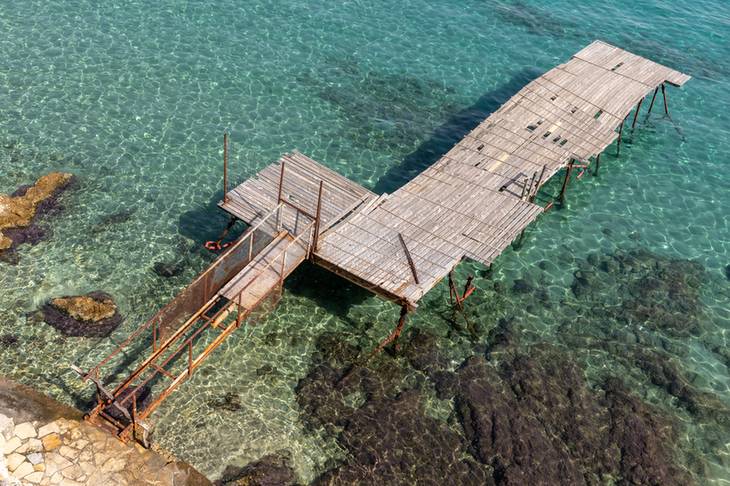
Where is Corfu Port and how far is the old town?
Corfu Port lies about 2 km north-west of the old town and roughly 3 km from the port gate on foot. The walk takes 20 to 25 minutes along a flat coastal route, and the bus and taxi alternatives both take a few minutes.
The port occupies the New Port area on the north-western edge of the capital, beside the Mandouki district. The old quarter, the Spianada and both fortresses lie to the south-east along the shore, which puts the walk on level ground the whole way.
Approximate road distances from the port set the scale for a day ashore.
| Destination | Approximate road distance from Corfu Port |
|---|---|
| Corfu Town old quarter | 2 km |
| Corfu Airport | 4 km |
| Kontokali | 4 km |
| Gouvia | 5 km |
| Kanoni | 6 km |
| Kommeno | 7 km |
| Dassia | 8 km |
| Ipsos | 10 km |
| Gastouri (Achilleion) | 12 km |
| Glyfada | 15 km |
| Paleokastritsa | 27 km |
| Kassiopi | 36 km |
| Sidari | 36 km |
| Kavos | 46 km |
Nothing on Corfu sits more than about 46 km from the quay. A ship in port for a working day therefore reaches any corner of the island and returns with time in hand, which is unusual among Mediterranean cruise calls.
How do cruise ships berth at Corfu Port?
Cruise ships berth alongside a long pier shared with the ferry traffic, so no tendering is involved. Depending on the berth, the walk to the terminal building runs 5 to 15 minutes on flat ground, with a free shuttle bus running between ship and terminal.
Alongside berthing is the single most useful fact for a passenger planning a day here. Tender ports cost an hour at each end of the day and constrain what fits between them; Corfu costs neither.
The arrival sequence runs in four stages.
- Disembark directly onto the quay, with no tender transfer at any berth
- Walk to the cruise terminal building, or take the free interport shuttle bus that runs between the ship and the terminal
- Clear the terminal, where restrooms, wi-fi, duty-free and car rental kiosks sit
- Leave through the port gate onto the road, where taxis, buses and meeting points wait
Berth allocation decides how far the first walk runs. Ships on the outer berths sit further from the terminal building, which is what the shuttle exists for. The port area itself is patrolled by the Port Authority and police, and it runs as a secure zone with controlled access.
Two or more ships calling on the same day compress the pattern. Shore excursions depart within the same window, taxis queue at the gate, and the old town fills across the same two or three hours. Leaving the area early, or later than the crowd, changes the day considerably.
Which ferries use Corfu Port?
Corfu Port handles ferries to Igoumenitsa on the Greek mainland, ferries to the Italian ports of Venice, Ancona, Bari and Brindisi, and passenger crossings to Saranda in Albania, alongside the cruise calls.
The four traffic types share the port complex, and each serves a different kind of journey.
Igoumenitsa — the mainland link
The short crossing to Igoumenitsa in Epirus carries most of the domestic traffic and connects Corfu to the Greek road and coach network. It runs frequently through the day across the year, with a reduced winter schedule.
Italy — the Adriatic routes
Ferries arrive from Venice, Ancona, Bari and Brindisi across the Adriatic. These are overnight or long-day crossings, and passengers landing from them often begin a wider Greek itinerary on Corfu.
Albania — Saranda
Passenger ferries and hydrofoils cross the narrow channel to Saranda, visible from the Corfu shore on a clear day. The crossing takes a fraction of the time the Italian routes involve and works as a day trip.
Cruise calls
Cruise ships berth at the New Port through the season, putting passengers ashore for a fixed number of hours before an evening departure.
One restriction affects visitors combining a car with a crossing: rental vehicles on Corfu do not board boats and do not cross Greek borders, so a ferry day runs on foot with the car parked. That arrangement is set out on the Corfu Port Car Rental page.
What facilities does the Corfu cruise terminal have?
The terminal building holds restrooms, free wi-fi, duty-free shopping, shuttle buses and car rental kiosks. Taxis wait at the terminal entrance and the local blue bus stops inside the port area.
Facilities match the port’s role as a transit point rather than a destination: sufficient for the hour between ship and town, and no reason to linger.
- Use the restrooms in the terminal building before heading into town
- Connect to the free wi-fi, which matters for passengers without a data roaming plan
- Shop at the duty-free units inside the terminal
- Take the free interport shuttle between the ship and the terminal building
- Find taxis at the terminal entrance and car rental kiosks inside
Cash is worth sorting before leaving the port area. Card payment is routine in the old town and along the eastern corridor, and less consistent in the hill villages and the far north, which matters for a day that heads inland.
Security in the port is managed by the Corfu Port Authority and the police, with checks on arrivals and departures. The controlled-access layout is why the walk out to the public road takes the time it does even from a near berth.
How do you get from Corfu Port into Corfu Town?
Four options serve the 2 km into the old town: walk it in 20 to 25 minutes on flat ground, take the blue bus that stops inside the port area, take a taxi from the terminal entrance, or collect a car at the port.
The short distance and the flat route make walking genuinely practical here, which is not true of every cruise port. The choice turns on mobility, heat and what happens after the old town.
Walking
The route from the port gate to the old town runs about 3 km along a flat coastal path, taking 20 to 25 minutes at an ordinary pace. It passes the Mandouki district and reaches the New Fortress on the northern edge of the historic centre. In July and August the midday heat is the limiting factor rather than the distance.
Blue bus
The local blue bus stops inside the port area and runs into the town centre, which makes it the cheapest option and a short ride. Services follow a published timetable that thins outside the summer season.
Taxi
Taxis wait at the cruise terminal entrance. They offer fixed rates into the town centre and hourly rates for island tours, which suits a party wanting a driver for the whole call.
Rental car
A car collected at the port covers the whole island for the day rather than the town alone. Corfu Port is a named free delivery point for local operators, so the handover happens at the quay.
The old quarter itself is walked in every case. Its Venetian street grid predates the car, and the lanes in the Campiello narrow below the width of a modern hatchback, so a driver parks on the ring and continues on foot.
What can you see in one day from Corfu Port?
The old town lies 2 km away, the Achilleion palace about 12 km, Paleokastritsa 27 km and Kassiopi 36 km. A call of eight hours reaches the town plus one or two destinations beyond it.
Three itineraries fit a standard call, each ending back at the quay with margin.
The town on foot — no transport needed
Walk or ride the 2 km and cover the UNESCO old quarter: the Liston arcade, the Spianada, the Old Fortress on its twin-peaked promontory, the New Fortress above the port, the Church of Saint Spyridon and the Campiello lanes. A single afternoon covers the lot on foot.
Town plus the Achilleion — about 12 km
Add the palace at Gastouri, built for Empress Elisabeth of Austria and later owned by Kaiser Wilhelm II, standing in terraced gardens above the east coast. The road climbs through the village and the site suits a two-hour visit.
The west coast — Paleokastritsa at 27 km
Cross the island to the bay that divides into coves beneath wooded headlands, with boats running from the beach to the sea caves. Climb to Lakones on the ridge above for the view back across the bay. This uses most of a day and rewards it.
One rule governs all three: build margin into the return. Traffic through Corfu Town slows in the middle of the day, and a published all-aboard time leaves no room for a late run. Route ideas across the island sit in Best Scenic Drives In Corfu Island: 8 Stunning Road Trips For Coastal Views, Villages And Hidden Bays.
Which beaches are reachable from Corfu Port in a day?
Gouvia sits 5 km north and Dassia 8 km, both on the sheltered east coast. Glyfada lies 15 km west on the open Ionian, and Paleokastritsa 27 km north-west.
The port has no beach of its own, but the island’s two coastlines both sit inside half an hour and they offer entirely different swimming.
East coast — sheltered, short drives
Gouvia at 5 km holds a shallow bay suited to families. Dassia at 8 km carries a long shingle beach with watersports and olive-grove shade. Ipsos at 10 km runs a narrow strip beside the coastal road, and Barbati beyond it holds the clearest water on this side.
West coast — sand, surf and cliffs
Glyfada at 15 km sits under wooded cliffs on broad sand. Agios Gordios at 17 km opens into a wide bay framed by rock stacks. Both face the open sea and take the evening sun, which suits a late-departing ship.
Paleokastritsa — 27 km
The bay splits into a series of coves beneath headlands, with clear deep water and boat trips to the caves. It is the furthest of the realistic beach options for a day ashore.
Access roads to the smaller coves turn to loose gravel on the final stretch, which is worth knowing for anyone driving a hire car. Beach access by road is mapped in Best Corfu Beaches Accessible By Car: 10 Scenic Shores Worth The Drive.
When is Corfu Port busiest?
Cruise traffic peaks between May and October, with the heaviest pressure on days when two or more ships call together. Ferry traffic to Italy and Igoumenitsa peaks across the same summer months.
The port’s rhythm is sharper than an airport’s, because a ship discharges its whole passenger list within a short window rather than spreading arrivals across a day.
Four patterns recur.
- Expect the port gate and the taxi rank to be busiest in the two hours after a ship berths
- Expect the old town to fill across the same window, particularly the Liston and the Spianada
- Expect heavier road traffic on the northern approach into town on multi-ship days
- Expect the Italian ferry arrivals to add freight and coach movement at their own hours
The practical response is to invert the crowd. Leaving the port area promptly and heading away from the town first, then returning to the old quarter in the afternoon, avoids both peaks. The reverse works equally: walk the town early and drive out later.
Outside the summer season the pattern flattens. Cruise calls reduce, ferry schedules thin, and the town runs at local pace.
What do visitors need to know before arriving at Corfu Port?
Five points cover most of it: alongside berthing with no tendering, a flat 20-to-25-minute walk into town, a free interport shuttle, blue buses stopping inside the port, and taxis at the terminal entrance.
Preparation for a call here is lighter than for most Mediterranean ports, because the geography does the work.
- Plan on walking if mobility and the weather allow, because the route is flat and short
- Carry cash for anything beyond the old town and the eastern corridor
- Agree onward transport before the call rather than at the gate on a multi-ship day
- Note the all-aboard time and work backwards, allowing for midday traffic through the town
- Leave the rental car on Corfu, because vehicles do not board boats or cross the border
Passport arrangements deserve a check for anyone planning the Albania crossing, since Saranda sits outside the EU and the requirements differ from a day spent on Corfu itself.
Ships holding passenger passports for immigration processing on some itineraries is the other detail worth confirming before the call, because identification is required to collect a hire car ashore.
How do you reach the rest of Corfu from the port?
The east-coast road north reaches Kontokali at 4 km, Gouvia at 5 km and Ipsos at 10 km. The southern road runs toward Kavos at 46 km, and the west coast lies 15 to 27 km across the island.
The port sits at the hinge of the road network beside the capital, so the whole island opens up in three directions without a long transfer first.
North — the resort coast and the corniche
The coastal road runs through Kontokali, Gouvia, Kommeno, Dassia and Ipsos within 10 km, then climbs the corniche past Barbati and Nissaki toward Kassiopi at 36 km. Acharavi, Roda and Sidari follow along the north coast at 36 to 37 km.
West — the ridge and the open sea
Roads cross the central belt to Pelekas at 12 km, Glyfada at 15 km, Agios Gordios at 17 km and Paleokastritsa at 27 km. All involve climbing over the ridge, so journey times run longer than the distances imply.
South — palace, lagoon and the island’s tip
The southern road passes Benitses at 10 km and Messonghi at 20 km toward the Korission Lagoon, Lefkimmi and Kavos at 46 km. It runs wider and faster than the west-coast roads.
Public transport reaches these destinations through Corfu Town rather than directly from the port. The KTEL intercity network departs from the bus station in the capital, so a resort journey by bus begins with the short transfer into town and a change there.
What is the difference between Corfu’s New Port and the Old Port?
The New Port on the north-western edge of the town handles cruise ships, international ferries and the Igoumenitsa service. The Old Port beside the old quarter is a smaller harbour used by local craft and excursion boats.
Two harbours serve Corfu Town, and confusing them costs a visitor time on arrival day.
The New Port is the working gateway. It sits beyond Mandouki on the north-western shore, holds the cruise terminal and the ferry berths, and operates as a controlled-access zone. Every cruise call and every international ferry uses it.
The Old Port lies against the northern edge of the old quarter, beneath the New Fortress. It is a small, sheltered basin, historically the town’s harbour and now used by smaller craft and seasonal excursion boats. It sits within the walkable historic centre rather than outside it.
Three practical consequences follow.
- Arrive at the New Port on any ship or international ferry, and plan the walk or transfer from there
- Look for excursion departures at the Old Port and at resort jetties rather than the cruise terminal
- Use the Old Port as a landmark on the walk into town, because the route passes close to it
Boat trips to Paxos, Antipaxos and the sea caves generally depart from the Old Port or from resort jetties along the coast rather than from the cruise berths, which matters when booking an excursion independently.
How long does a day ashore at Corfu Port really last?
Subtract the walk or shuttle at both ends and the all-aboard margin from the published call length. An eight-hour call typically leaves six to seven usable hours ashore, which reaches the town plus one destination beyond it.
Planning against the published times rather than the usable ones is the commonest mistake on a port day, and it is easy to avoid.
Four deductions apply to every call.
- Allow 10 to 20 minutes from the ship to the port gate, depending on berth and shuttle timing
- Allow the same again on the return, plus queueing at the gangway on a busy departure
- Return ahead of the published all-aboard time rather than at it
- Add a margin for traffic through Corfu Town, which slows in the middle of the day
The arithmetic works out favourably here compared with tender ports, where the boat transfer alone can absorb two hours of a call. Alongside berthing at Corfu returns most of that time to the visitor.
The practical planning rule is to fix the furthest point of the day first and work backwards. Paleokastritsa at 27 km sets a different schedule from the Achilleion at 12 km, and both set a different one from an afternoon spent in the old quarter on foot.
What is worth seeing near Corfu Port?
The New Fortress stands directly above the port, the old quarter lies 2 km south-east, and Kanoni with the Vlacherna monastery sits 6 km south. The Achilleion palace is about 12 km away.
Four sights sit close enough to reach without a long transfer.
The New Fortress — immediately above the port
The Venetian fortification on the hill above the New Port is the first landmark a walker meets on the way into town. Its ramparts look back over the harbour and across to the mainland.
The old quarter — 2 km
The Liston arcade, built under French rule, faces the Spianada, the large open square where the British introduced cricket. The Old Fortress occupies the promontory beyond it. The Campiello quarter behind holds the narrowest lanes and the oldest fabric.
Kanoni, Vlacherna and Pontikonisi — 6 km
The Kanoni peninsula looks across the mouth of the Chalikiopoulou lagoon to the Vlacherna monastery on its causeway and the wooded islet of Pontikonisi behind. The airport runway runs along the far side of the same lagoon.
The Achilleion, Gastouri — about 12 km
The palace stands in terraced gardens above the coast, reached by a climbing road through the village. It combines with Benitses on the shore below for a half-day.
The island as a whole is covered on the Corfu Airport Rent a Car guide, and the capital in detail on the Corfu Town Car Rental page.
Where do you eat and shop near Corfu Port?
The old quarter 2 km away holds the restaurants, cafés and shops. The Liston arcade carries the best-known terraces, and the market streets behind the Spianada hold the smaller tavernas and food shops.
The port area itself is a transit zone rather than a dining destination, with the terminal duty-free covering the immediate needs. The eating happens in town.
The Liston
The arcaded terrace facing the Spianada was built under French rule and now carries a line of cafés and restaurants. It is the most visible option and priced accordingly, and the setting facing the cricket ground and the Old Fortress is the reason people pay it.
The Campiello and the market streets
Behind the Liston, the narrow lanes of the old quarter hold smaller tavernas, bakeries and delicatessens. Prices fall as the streets narrow, and the local food shops sell the island specialities worth carrying back aboard.
Mandouki — on the walk in
The district between the port and the historic centre is residential rather than touristic, with everyday tavernas and shops along the route. It suits a stop on the walk in or out rather than a destination in itself.
Two practical points apply to a port day. Card payment is routine across the old town, so cash is needed mainly for a day heading inland. And the tavernas fill across the same window the ships discharge, so eating early or late avoids the queue exactly as it avoids the crowds at the sights.
What is the history of Corfu’s harbour?
Corfu Town grew up between two Venetian fortresses guarding the approaches from the sea. The Old Fortress occupies the promontory east of the centre and the New Fortress stands on the hill above the modern port.
The town’s defences explain its shape, and both fortresses are visible from a ship on the approach.
The Old Fortress sits on a twin-peaked rocky promontory that was once separated from the town by a sea channel. It carried the earliest fortifications and remained the core of the defences through the Venetian centuries.
The New Fortress rises on the hill above the New Port, built later to cover the western approaches. Its ramparts overlook the modern harbour and the channel toward the mainland, which is why it is the first landmark a walker meets coming from the quay.
Between and behind them, the Venetian street grid of the Campiello grew tall and narrow because the walls constrained the town’s footprint. That density is what earned the old town its UNESCO listing, and it is the reason the lanes take a modern car so badly.
The harbour’s role has stayed constant across all of it. The channel to the mainland is narrow, the anchorage is sheltered, and the island sits at the entrance to the Adriatic, which is why the port has served Venetian galleys, British warships and modern ferries in turn.
How does Corfu Port compare with Corfu Airport as an arrival point?
The port sits 2 km from the old town and the airport 3 km, so both land a visitor within minutes of the capital. The port suits itineraries continuing to the mainland or Italy; the airport suits flight arrivals.
Corfu is unusual in having both gateways inside the capital’s built-up area, which removes the long transfer that most island arrivals involve.
Three differences shape the choice for a traveller who has one.
Onward connections differ. The port links to Igoumenitsa and the Greek road network, to the Italian Adriatic ports and to Albania. The airport links to the domestic Greek network and the northern European markets.
Arrival pace differs. A ship or ferry discharges its passengers in a concentrated burst; an airport spreads arrivals across the schedule, with the summer weekends as the exception.
Onward transport differs slightly. Both have taxis and buses at the door, and both are named free delivery points for local car rental, so a one-way arrangement between them carries no relocation charge.
The combination that suits many itineraries is arriving by sea and leaving by air, or the reverse. Distances and terminal detail for the air gateway sit on the Corfu Airport (CFU) Guide, and rates for Corfu Airport Car For Rent sit on the home page.
Corfu Port — frequently asked questions
How far is Corfu Port from the old town?
The old quarter lies about 2 km south-east of the port, and the walk from the port gate runs roughly 3 km on flat ground, taking 20 to 25 minutes. The blue bus stops inside the port area and taxis wait at the terminal entrance.
Do cruise ships tender at Corfu?
No. Ships berth alongside at a long pier shared with the ferry traffic, so passengers step directly onto the quay. Depending on the berth, the walk to the terminal building runs 5 to 15 minutes, with a free interport shuttle bus available.
Is there a shuttle bus at Corfu cruise port?
A free interport shuttle runs between the ship and the cruise terminal building. Beyond the terminal, the local blue bus stops inside the port area and runs into the town centre on a published timetable.
Can you walk from Corfu cruise port to the old town?
The route is flat and takes 20 to 25 minutes from the port gate, passing the Mandouki district and reaching the New Fortress at the northern edge of the historic centre. Midday heat in July and August is the practical limiting factor.
Which ferries leave from Corfu Port?
Ferries run to Igoumenitsa on the Greek mainland, to the Italian ports of Venice, Ancona, Bari and Brindisi, and passenger services and hydrofoils cross to Saranda in Albania. Cruise ships berth at the New Port through the season.
What facilities are in the Corfu cruise terminal?
The terminal holds restrooms, free wi-fi, duty-free shopping, shuttle buses and car rental kiosks. Taxis wait at the entrance. The port area is patrolled by the Corfu Port Authority and the police, with controlled access.
How far is Corfu Port from the airport?
Corfu Airport sits about 4 km south of the port, on the far side of the town centre. Both sit within minutes of the old quarter, which makes an arrive-by-sea, leave-by-air itinerary straightforward.
What can you do in Corfu in one day from a cruise ship?
The old town at 2 km fits an afternoon on foot. Adding the Achilleion palace at about 12 km makes a fuller day. Paleokastritsa at 27 km uses most of a call and reaches the west coast coves and the sea caves.
Can I take a hire car onto the ferry from Corfu Port?
Local rental vehicles do not board boats and do not cross Greek borders. A crossing to Igoumenitsa, Saranda, Paxos or Antipaxos runs on foot as a passenger, with the car parked, or the car is returned at the port before the sailing.
Is Corfu Port safe?
The port area operates as a controlled-access zone patrolled by the Corfu Port Authority and the police, with checks on arrivals and departures. Ordinary precautions apply in the town itself as in any busy tourist centre.
When is the best time to visit Corfu by cruise?
Cruise calls run from spring through autumn, with the heaviest traffic between June and September. May and October bring lighter crowds, cooler walking weather and a quieter old town, while the sea remains warm enough for swimming in October.
Where do rental representatives meet passengers at Corfu Port?
The meeting point is agreed at booking against the vessel and its arrival hour, so the representative is waiting when the passenger comes ashore. Naming the ship or ferry route in the reservation lets the delivery be timed to the actual berth.
Is there wi-fi at Corfu cruise terminal?
Free wi-fi is available in the terminal building, alongside restrooms, duty-free shopping and car rental kiosks. It is worth connecting before leaving the port for passengers without a data roaming plan, because it covers the terminal rather than the town.
Which port do the Paxos excursion boats leave from?
Excursion boats to Paxos, Antipaxos and the sea caves generally depart from the Old Port beside the historic centre, or from resort jetties along the coast, rather than from the cruise berths at the New Port. Booking independently is worth checking against the departure point.
Corfu International Airport, the island’s air gateway, is documented at Corfu International Airport.
Which other Corfu locations and guides are worth reading?
Triple Seven covers seven pick-up locations across Corfu and publishes a travel guide for each of them. The rental pages carry rates, delivery and terms; the guides carry the place itself.
Corfu car rental locations
- Gouvia Car Rental
- Corfu Town Car Rental
- Corfu Port Car Rental
- Ipsos Car Rental
- Dassia Car Rental
- Kommeno Car Rental
- Kontokali Car Rental
Corfu travel guides
- Corfu Airport (CFU) Guide
- Corfu Town Guide
- Ipsos Guide
- Dassia Guide
- Gouvia Guide
- Kommeno Guide
- Kontokali Guide